THANK YOU to the Westside Music Conservatory for hosting this page!
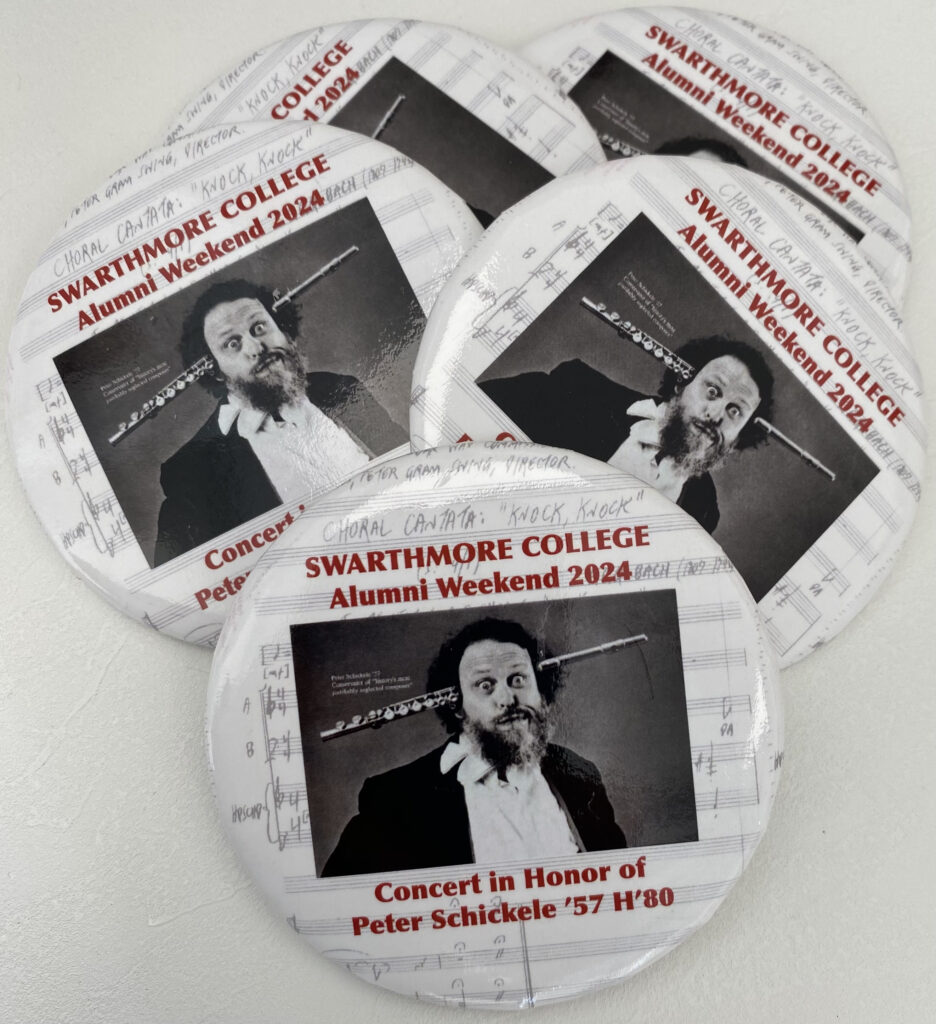
SWARTHMORE COLLEGE
Alumni Weekend 2024
Concert in Honor of Peter Schickele ’57 H’80
An All-Alumni Musical Tribute
Friday, May 31, 2024 • 5:00pm
Lang Concert Hall • Lang Music Building
Swarthmore College
Peter Schickele Concert Program
(scroll down • 2 pages)
ARCHIVAL VIDEO
NOTE: the video belongs to the Music Department and is being shared via Google Drive. Google Drive has a limit on how many views are allowed in a 24-hour period. The counter will reset every 24 hours, so check back if you are seeing an error message. Downloading is possible, but for personal archival purposes only. THANKS for understanding.
PROGRAM NOTES & TEXTS
SOURCES
https://www.schickele.com/cgi/catalogue.pl?list=all
https://www.schickele.com/wp/works/books/
Swing, Swing, Swing by Peter Schickele
3-Part Round (1979) for Professor Peter Gram Swing
Who’s got the patience of Job,
and the fortitude of good old Saint Peter?
Swing, Swing, Swing, St. Peter,
Swing, Swing, Swing, St. Peter,
Swing, Swing, Swing, St. Peter,
Swing, Swing, Swing,
Swing, Swing, Swing,
Saint Peter, Swing.
Must tell him how grateful I am;
Perhaps I will send him a telegram.
Swing, Swing, Swing, Telegram,
Swing, Swing, Swing, Telegram,
Swing, Swing, Swing, Telegram,
Swing, Swing, Swing,
Swing, Swing, Swing,
Swing, to Mister Peter Swing.
OO-
OO-
Swing, Swing, Swing,
Swing, Swing, Swing,
Swing, Swing, Swing,
Swing, Swing, Swing,
Swing, Swing, Swing,
Swing, here’s to Peter Swing.
Liebeslieder Polkas, S. 2/4, by P.D.Q. Bach
SATB, Piano 5-Hands
(April 17, 1979, revised September 7, 1979 • 24 minutes)
Commissioned by the California University at Hayward, University Singers
Selected performances:
December 27, 28, 29, and 30, 1979, at Avery Fisher Hall in Lincoln Center, in New York City
December 27, 28, and 29, 2005 at Symphony Space in New York City
The Liebeslieder Polkas is the first opus of P.D.Q. Bach’s to be discovered in which he inflicted his music on the work of well-known poets, or even know poets, for that matter. The fact that all the poets represented are English leads one to surmise that P.D.Q.’s drinking companion Jonathan “Boozey” Hawkes had something to do with instigating the piece; Hawkes eventually married P.D.Q.’s cousin Betty-Sue and returned to his native Liverpool, where the two of them spent their senility publischin gmost of the unmourned composer’s vocal music.
As far as observing the integrity of these already-famous poems is concerned, P.D.Q.’s attitude ranges from indifference to contempt. Some of the poems are set complete, others are rather haphazardly cut, some contain completely spurious interpolations, and in one case—Ben Jonson’s beloved Song To Celia—the poem has been extensively rewritten to reflect the composer’s besotted Weltanschauung.
A word about the fifth hand in the piano part: When Brahms wrote his Liebeslieder Waltzes (in obvious imitation of P.D.Q. Bach, but, as usual, without giving the earlier composer any credit) he scored the accompaniment for piano four hands; by adding a third person at the piano P.D.Q. not only expanded the range of the accompaniment, but he also made sure that there was always one hand free for turning pages. Or, to look at it another way, he made life much more interesting for the page-turner.
Professor Peter Schickele
No. 7 – Song to Celia
Eye me only with thy drink,
And I will pledge with this;
Or leave me some wine but in the cup,
And I’ll not look to kiss.
The thirst that from the soul doth rise
Doth ask a drink divine;
But if Jove’s nectar I can’t sip,
Some ale will do just fine.
I sent thee late a rosy wreath,
Not so much hon’ring thee
As giving it a hope that there
It could not withered be.
But thou thereon didst only breathe,
And sent’st it back to me;
Since when it smells, I kid thee not,
Of pretzels and chablis.
No. 10 – Who is Sylvia?
Who is Sylvia? What is she,
That all our swains commend her? (Boy do they commend her.)
Holy, fair and wise is she;
The heaven such grace did lend her, (Brother, you should she what they lent her.)
That she might admired be.
Is she kind as she is fair?
For beauty lives with kindness. (Beauty shacks up with kindness.)
Love doth to her eyes repair,
To help him of his blindness, (He has a little trouble with blindness.)
And, being help’d, inhabits there.
Then to Sylvia let us sing
That Sylvia is excelling; (Sylvia is excelling.)
She excels each mortal thing
Upon the dull earth dwelling:
To her let us garlands bring.
Who is Sylvia?
Helen is a beauty, the fairest in the land;
Maid Marian’s a grouple with the Robin Hood band;
Godiva is a lady, as ev’ryone can see,
But who is Sylvia, what is she?
Joanie is a martyr, and Lizzie is a queen;
And Jezebel’s a no-no, if you know what I mean;
Priscilla is a pilgrim, and Daphne is a tree,
But who is Sylvia, what is she?
Who is Sylvia?
Who, me?
Who is Sylvia?
Yeah, thee!
Who is Sylvia, what is she gonna say when she sees me?
Mi mi mi. Hey!
Passacaglia In C Minus by Professor Peter Schickele
Quodlibet for String Quartet
(April 24 – 27, 2000 • 7.5 minutes)
The Latin term quodlibet may be translated as “whatever you please,” but in the musical world
it has come to mean a work in which themes from different pieces, often by different composers, are combined in ways not originally intended. My favorite form of quodlibet is one in which the various themes not only follow each other, sometimes morphing from one into another, but in which the themes get piled on top of each other; I once did one in which themes from all nine Beethoven symphonies were being played simultaneously.
The PASSACAGLIA IN C MINUS contains more than two dozen melodies (none of them by me), within its six minutes; they range from the famous (“Greensleeves”) to the arcane (one of the Brahms clarinet sonatas). The wit results from the surprise at what’s coming over the horizon, and, often, from the inappropriateness of the juxtapositions (because of anachronism, for instance). But it’s meant to be enjoyed – it’s not a test. The trick to assembling this kind of piece is to do it in such a way as to provide the audience members with a pleasing listening experience, whether or not they recognize the themes.
This work is an arrangement and revision of the “Chaconne à son goût,” an orchestral version composed in 1973. The passacaglia and chaconne are forms usually consisting of variations over a repeated bass line. In this case the bass line at the beginning and end of the work is from Bach’s “Passacaglia in C Minor” for organ, while the middle section is constructed over the bass line of the last of Brahms’s “Variations on a Theme by Haydn.”
The title of this piece comes from something a friend of mine actually heard on the radio: an announcer introducing a concerto as being in A Minus instead of A Minor – too good a title to let lie.
Professor Peter Schickele
Iphigenia In Brooklyn, S. 53, 162, by P.D.Q. Bach
Bargain Counter Tenor, 3 Double Reeds, Trumpet Mouthpiece, Wine Bottle, Harpsichord, String Quartet
(May 19, 1963 • 10 minutes)
Premiere: May 1963, Joshua Rifkin (countertenor) at the Juilliard School
Selected performances:
April 24, 1965 at Town Hall, December 28, 1965 at Philharmonic Hall in New York City
December 26 and 29, 1972 at Philharmonic Hall in New York City
December 26, 27, 28, and 30, 1981 at Carnegie Hall, December 27, 28, and 30, 1995 at Carnegie Hall in New York City
I. Trumpet Involuntary
II. Aria
As Hyperion across the flaming sky his chariot did ride,
Iphigenia herself in Brooklyn found.
III. Recitative: “And Lo!”
And lo, she found herself within a market
And all around her, fish were dying
And yet their stench did live on.
IV. Ground: “Dying”
Dying, and yet in death alive.
V. Recitative: “And in a Vision”
And in a vision, Iphigenia saw her brother Orestes,
Who was being chased by the Amenities.
And he cried out in anguish,
“O ye gods, who knows what it is to be running?
Only he who is running knows.”
VI. Aria: “Running“
Running knows.
The Household Moose by Peter Schickele
Suite for Piano
(August 8, 1956 • 7 minutes)
A collection of short pieces influenced by Darius Milhaud’s The Household Muse (Schickele dedicated this work to Milhaud).
III. La Belle Jeune Fille Française
VI. Le Campane
For more details: please watch this video: https://youtu.be/30oZl1rwiHo?si=j1k6jKrCZ0wgugDg
This video features Peter Schickele’s introductions to each piece with engaging reflections and memories of his summer of 1956 at age 21. Included alongside each performance are thoughtful and charming drawings by David Schickele, Peter’s late brother. This was influenced by the drawings found on each page of Milhaud’s The Household Muse score. The premiere video release of The Household Moose. Schickele’s autobiographical comments are interspersed between the recorded musical sketches by pianist Laura Leon.
Three Songs for a Wedding by Peter Schickele
Medium Voice and Piano
(July 1, 1981, revised and arranged for Piano on February 18, 1985 • 8 minutes)
Text of first and last songs by William Cavendish, and of the second song by Dante Gabriel Rosetti. Originally arranged for medium voice and guitar, written for the marriage of Joan Sindall and Kiril Uspensky.
2. Sudden Light
I have been here before,
But when or how I cannot tell:
I know the grass beyond the door,
The sweet keen smell,
The sighing sound, the lights around the shore.
You have been mine before,
How long ago I may not know,
But just when at that swallow’s soar
Your neck turned so,
Some veil did fall,
I knew it all of yore.
Has this been thus before?
And shall not thus time’s eddying flight
Still with our lives our love restore
In death’s despite,
And day and night yield one delight once more?
Elegies by Peter Schickele
Clarinet and Piano
(November, December 1974 • 10 minutes)
3. Ceremony
Two Songs on Elizabethan Lyrics by Peter Schickele
Medium Voice and Piano
(1998 • 5 minutes)
Premiere: August 14, 1998, Michèle Eaton (soprano) and David Deschamps (piano), in Kent, CT
2. Fain Would I Change That Note
Fain would I change that note
To which fond love hath charmed me,
Long, long to sing by rote,
Fancying that that harmed me.
Yet when this thought doth come,
“Love is the perfect sum of all delight,”
I have no other choice
Either for pen or voice, to sing or write.
O Love!
They wrong the much
That say thy sweet is bitter;
When thy ripe fruit is such
As nothing can be sweeter.
Fair house of joy and bliss
Where truest pleasure is, I do adore thee:
I know thee what thou art,
I serve thee with my heart and fall before thee.
Fain would I change that note.
Echo Sonata for Two Unfriendly Groups Of Instruments, S. 999999 by P.D.Q. Bach
Flute, Oboe, Bassoon, French Horn, Trumpet in B-flat, Trombone
(December 13, 1966 • 3 minutes)
Premiere: December 26, 1966 at Carnegie Hall in New York City
Selected performances: December 26, 27, 28, and 30, 1987 at Carnegie Hall in New York City
In this work P.D.Q. demonstrates his inability to handle the antiphonal concept, a concept so central to the structure of Baroque instrumental music that P.D.Q. could not more ignore it than understand it. The musical statements made by the woodwinds, if taken alone, would seem to indicate a giant step forward for the neophyte Bach, since they are surprisingly well conceived when compared to the clumsy vagaries of the earliest TRAUMAREI; however the answers to these statements, played by the brasses, immediately erase any overly optimistic expectations the listener may have developed during the first four measures.
One is tempted to speculate that the to instrumental groups in the ECHO SONATA represented to P.D.Q. Bach two opposing aspects of his own personality, and in this light it is interesting to note that it is the vulgar brasses, and not the civilized woodwinds, who have the last word. This work, in fact may be viewed as a sort of musical Mein Kampf, a blueprint for future outrages which, although certainly innocuous compared to those perpetrated by that later scourge of Europe, would nevertheless probably have be prevented had people realized what they were letting themselves in for.
Professor Peter Schickele
December 20, 1991
Beulah, North Dakota
Waiting out a blizzard.
Erotica Variations, S. 36EE, by P.D.Q. Bach
Banned Instruments and Piano
Windbreaker, Balloons, Slide Whistle, Slide Windbreaker, Lasso d’Amore, Foghorn/Bell/Kazoo/Gargle
(February 28, 1972 • 6 minutes)
Theme: Windbreaker
Variation I: Balloons
Variation II: Slide Whistle
Variation III: Slide Windbreaker [Wood Blocks]
Variation IV: Lasso D’Amore
Variation V: Foghorn [Bicycle Horn] / [Desk] Bell / Kazoo / Gargle
In an article entitled “P.D.Q. Bach: Can It Happen Here?” appearing in the August 1973 issue of The Musical Hindquarterly (a publication of the A.M.J.),* Professor Paul Behrer argues that one of the reassuring reasons that a P.D.Q. Bach could not flourish in twentieth-century America is the existence now of quite stringent copyright laws, and certainly the lack of such laws in eighteenth-century Germany allowed that aspect of P.D.Q. Bach’s stule that has been called “manic plagarism” to become develped to a degree that would be beyond the bounds of possibility in this day and age. As a general rule, the original passages in P.D.Q.’s music are due to his inability to remember how the piece that he was stealing from went.
In 1804 Immanuel Kant coined the phrase “absolute identity”; he invented the term not, as several modern philosophy textbooks state, to describe the soul’s highest degree of self-knowledge, but rather to describe the relationship between the theme of P.D.Q. Bach’s “Erotica” Variations and that of Beethoven’s “Eroica” Variations. The latter were written in 1802, which is probably when P.D.Q. heard them, although they are now reffered to by the same name as the Third Symphony, which employs the same them, but which Beethoven did not complete until 1804.**
Most of the instruments used in the “Erotica” Variations had been employed by P.D.Q. in other works, but the fourth variation introduces a new and unusually interesting instrument. Early in the eighteenth century, Viennese cowboys developed a technique of twirling their lariats over their heads with such great speed that a musical pitch was produced; by the end of the century the “lasso d’amore,” as it came to be called, had been refined to the point of having a range off almost two octaves and a tone that Mozart called “weird,” but the modifications that had made this development possible rendered it useless for roping cattle, and within a few decades the American West had replaced Vienna as the cow capital of the world.
*American Musicological Junta.
**“Erotica” Symphony was originally dedicated to Napoleon, but Beethoven tore up the dedication page in a fit of disgust when he learned that Napoleon had been doing ads for Courvoisier brandy.
From The Definitive Biography of P.D.Q. Bach by Prof. Peter Schickele, copyright (c) 1976 by Peter Schickele, published by Random House, Inc., New York, Used by permission.
“Knock, Knock”, S. 4/1, Choral Cantata, by P.D.Q. Bach
SATB chorus and soloists, 3 Flutes, Harpsichord, Contrabass
(July 19, 1985, revised April 5, 1990 • 14 minutes)
Commissioned by Swarthmore College
Premiere: November 9, 1985, the Swarthmore College Chorus with Peter Schickele, conductor
Selected performances: December 26, 28, and 30, 1990, at Carnegie Hall in New York City
I. Recitative and Chorus: Knock, Knock
Recitative
Knock, knock.
Who is there?
Ida.
Ida who?
Chorus
I duhream of Jeanie with the light brown hair.
II. Recitative and Chorus: How Many Psychiatrists
Recitative
How many psychiatrists does it take to change a light bulb?
Chorus
One, but the light bulb has to really want to change.
III. Recitative and Chorale: What is the Question
Recitative and Chorale
What is the question to which the answer is: Washington Irving?
What was the name of our first president, Seymour?
What is the question to which the answer is: 9W
Do you spell your name with a “V,” Mister Wagner?
What is the question to which the answer is: Doctor Livingston, I presume?
What is your full name, Doctor Presume?
IV. Recitative and Chorus: So This Guy
Recitative and Chorale
So this guy who works at an aquarium gets summoned by his boss,
who is looking very worried, and she says to him,
“I just walked by the dolphin tank, and they’re feeling very amorous;
they’re doing all sorts of things to each other, and the trouble is,
in less than an hour we’ve got three busloads of second graders coming
we can’t have them watching those naughty dolphins behaving
as if they were in a porno flick
Now there’s only one thing that acts as an antiaphrodisiac for dolphins,
and that’s the meat of baby seagulls,
So I want you to go down to the seashore, catch yourself some baby seagulls,
put them in this bag, and hurry on back.
But be careful; a lion escaped from the zoo this morning,
and though he was heavily sedated, he still just might be dangerous.
Okay, get going, and make it snappy.”
So the guy takes a shortcut through the forest to the seashore,
he fills the bag with baby seagulls, and he’s walking back through the forest,
When he sees the lion, and it is lying across the path directly in front of him!
It’s too late to run away, and the feline does seem very placid,
so, summoning up all his courage, he steps across the lion.
Nothing happens, and so, with much relief, the guy begins to resume his journey,
when all of a sudden a policeman steps out of the forest;
he grabs the guy by the arm, and says to him,
“You’re under arrest.”
The guy can’t believe it; he says,
“Tell me, officier, what’s the charge?”
and the policeman says,
“Transporting young gulls across a staid lion for immoral porpoises.”
Ah—